
Case Reports in Clinical Cardiology Journal | Cambridge City
  • info.clinical@cardiologycasereportsjournal.org
  • CB1 OBG, Cambridge City, UK
  • Submit Manuscript

Article Details

Case Report
Volume 6, Issue 4

Unmasking of Brugada Syndrome Type 1 from Lithium Administration

Ethan Swartz1*, Navid Radfar1, Harsh Singh1, Serin Varughese1, Eugene Kim1, Meet Shah2, Eison de Guzman2, Delia Cotiga3 and Renjit Thomas3

1Department of Internal Medicine, Rutgers New Jersey Medical School, 185 South Orange Avenue, Newark, NJ, USA
2Division of Cardiology, Department of Medicine, Rutgers New Jersey Medical School, 185 South Orange Avenue, Newark, NJ, USA
3Department of Cardiology, VA New Jersey Healthcare System, 385 Tremont Avenue, East Orange, NJ, USA

*Corresponding author: Ethan Swartz, Department of Internal Medicine, Rutgers New Jersey Medical School, 185 South Orange Avenue, Newark, NJ, USA.
E-mail: es1398@njms.rutgers.edu

Received: July 16, 2026; Accepted: August 03, 2026; Published: August 15, 2026

Citation: Swartz E, Radfar N, Singh H, et al. Unmasking of Brugada Syndrome Type 1 from Lithium Administration. Case Rep Clin Cardiol J. 2026; 6(4): 187.
Unmasking of Brugada Syndrome Type 1 from Lithium Administration
Abstract

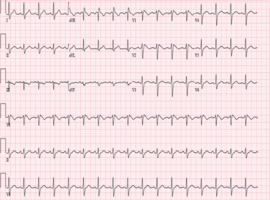
Brugada syndrome (BrS) is an inherited cardiac channelopathy associated with characteristic electrocardiographic (ECG) changes and an increased risk of sudden cardiac death (SCD). These ECG findings are often concealed and may be unmasked by sodium channel blocking agents. Lithium, a first-line mood stabilizer for bipolar disorder, exerts clinically relevant cardiac sodium channel blockade, though its association with BrS is infrequently reported. We describe a case of a 28-year-old male with bipolar disorder type I who presented with chest pain and was found to have a type 1 Brugada ECG pattern while taking lithium therapy. Following discontinuation of lithium and transition to aripiprazole, repeat ECG one year later demonstrated resolution of the Brugada pattern. Given lithium’s widespread use and the transient nature of drug-induced Brugada patterns, heightened clinical awareness is essential to avoid misdiagnosis and mitigate arrhythmic risk.