
Case Reports in Clinical Cardiology Journal | Cambridge City
  • info.clinical@cardiologycasereportsjournal.org
  • CB1 OBG, Cambridge City, UK
  • Submit Manuscript

Article Details

Case Report
Volume 6, Issue 4

Positional Coronary Subclavian Steal Syndrome from Thoracic Outlet Compression

Husam Shadid*, Sana Gupta, Sruthi Kotaru and Jagadeesh K. Kalavakunta

Department of Cardiology, Western Michigan University Homer Stryker School of Medicine, Beacon Kalamazoo Hospital, Kalamazoo, Michigan, USA

*Corresponding author: Husam Shadid, Department of Cardiology, Western Michigan University Homer Stryker School of Medicine, Beacon Kalamazoo Hospital, Kalamazoo, Michigan, USA. E-mail: shadidh@gmail.com

Received: September 04, 2026; Accepted: September 22, 2026; Published: October 05, 2026

Citation: Shadid H, Gupta S, Kotaru S, et al. Positional Coronary Subclavian Steal Syndrome from Thoracic Outlet Compression. Case Rep Clin Cardiol J. 2026; 6(4): 188.
Positional Coronary Subclavian Steal Syndrome from Thoracic Outlet Compression
Abstract

Background: Coronary subclavian steal syndrome (CSSS) is an uncommon cause of myocardial ischemia following coronary artery bypass grafting (CABG) utilizing a left internal mammary artery (LIMA) graft. It is most frequently caused by atherosclerotic subclavian artery stenosis, whereas CSSS resulting from thoracic outlet syndrome and dynamic extrinsic compression is exceedingly rare.
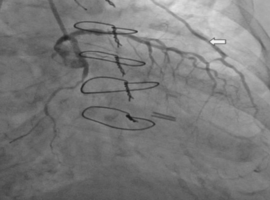
Case Presentation: A 66-year-old woman with prior CABG with LIMA to Left Anterior Descending (LAD) and saphenous vein grafts presented 8 years later with recurrent exertional angina despite optimal medical therapy. Coronary angiography revealed proximal subclavian compression with retrograde LIMA flow. Provocative neck rotation during angiography markedly worsened LIMA flow, confirming dynamic extrinsic compression consistent with thoracic outlet syndrome as the underlying mechanism of CSSS.
Management and Outcome: She underwent carotid-subclavian bypass with complete resolution of anginal symptoms. At five-year follow-up, she remained asymptomatic, and nuclear stress testing demonstrated no evidence of inducible ischemia.
Conclusion: This case highlights the importance of provocative positional maneuvers during angiography when evaluating suspected CSSS, particularly when dynamic extrinsic compression is suspected. Identifying the underlying mechanism is critical for appropriate management, and surgical bypass can provide durable long-term symptom relief and restoration of myocardial perfusion in patients with thoracic outlet syndrome-related CSSS.

Keywords: Coronary subclavian steal syndrome; Coronary artery bypass grafting; Thoracic outlet syndrome; Left internal mammary artery