
Case Reports in Clinical Cardiology Journal | Cambridge City
  • info.clinical@cardiologycasereportsjournal.org
  • CB1 OBG, Cambridge City, UK
  • Submit Manuscript

Article Details

Case Report
Volume 6, Issue 3

Coexistence of Anomalous Right Coronary Artery Originating from the Left Coronary Cusp and Interventricular Membranous Septal Aneurysm: A Rare Dual Congenital Findings

Khalid Bin Thani1,2*, Wafa Alhayki1 and Yousef M. Alajmi2

1Department of Cardiology, Salmaniyah Medical Complex, Manama, Kingdom of Bahrain
2College of Medicine and Medical Sciences, Arabian Gulf University, Manama, Kingdom of Bahrain

*Corresponding author: Khalid Bin Thani, Department of Cardiology, Salmaniyah Medical Complex, Manama, Kingdom of Bahrain; College of Medicine and Medical Sciences, Arabian Gulf University, Manama, Kingdom of Bahrain.
E-mail: kbinthani@hotmail.com

Received: April 18, 2026; Accepted: May 04, 2026; Published: May 15, 2026

Citation: Thani KB, Alhayki W, Alajmi YM. Coexistence of Anomalous Right Coronary Artery Originating from the Left Coronary Cusp and Interventricular Membranous Septal Aneurysm: A Rare Dual Congenital Findings. Case Rep Clin Cardiol J. 2026; 6(3): 181.
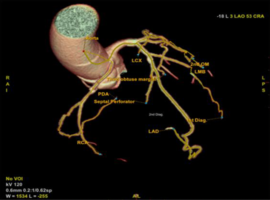
Coexistence of Anomalous Right Coronary Artery Originating from the Left Coronary Cusp and Interventricular Membranous Septal Aneurysm: A Rare Dual Congenital Findings
Abstract

We present a rare case of a 67-year-old woman with exertional chest discomfort who was found on coronary computed tomography angiography (CCTA) to have two coexisting congenital cardiac anomalies; an anomalous right coronary artery (RCA) originating from the left coronary cusp (LCC) with an inter-arterial course between the aorta and pulmonary trunk, and an interventricular membranous septal aneurysm (IVMSA). Anomalous RCA with inter-arterial course is considered a malignant variant due to its association with myocardial ischemia and sudden cardiac death [1,2,6], while IVMSA, although often incidental, may be associated with conduction disturbances and thromboembolic complications [4,5,8]. The patient was discussed in a multidisciplinary team and surgical correction was offered, but she opted for conservative management and declined surgical intervention. Recognition of such dual congenital anomalies is crucial, as both may carry significant prognostic and management implications. This case underscores the essential role of CCTA in accurately delineating complex coronary and structural anomalies, guiding individualized treatment decisions, and optimizing patient counseling and follow-up [7].

Keywords: Anomalous right coronary artery; Left coronary cusp; Inter-arterial course; Interventricular membranous septal aneurysm; Coronary CT angiography