
Case Reports in Clinical Cardiology Journal | Cambridge City
  • info.clinical@cardiologycasereportsjournal.org
  • CB1 OBG, Cambridge City, UK
  • Submit Manuscript

Article Details

Case Report
Volume 6, Issue 5

Broadening the TBX4/TBX2 Phenotypic Spectrum: Surviving Neonatal ECMO and Reverse Potts Shunt for Suprasystemic Pulmonary Hypertension

Nathan Ostlie1*, Gage Alvernaz2, Dorothy Curran1, Nathan Rodgers3, Juan Carlos Samayoa3 and Erin McHugh1

1Division of Pediatric Pulmonary and Sleep Medicine, Department of Pediatrics, University of Minnesota Medical School, Minneapolis, MN, USA
2Division of Pediatric Pulmonary and Sleep Medicine, University of California, Davis; Davis, CA, USA
3Division of Pediatric Cardiology, Department of Pediatrics, University of Minnesota Medical School, Minneapolis, MN, USA

*Corresponding author: Nathan Ostlie, Division of Pediatric Pulmonary and Sleep Medicine, Department of Pediatrics, University of Minnesota Medical School, Minneapolis, MN, USA. E-mail: ostli027@umn.edu

Received: October 23, 2026; Accepted: November 08, 2026; Published: November 20, 2026

Citation: Ostlie N, Alvernaz G, Curran D, et al. Broadening the TBX4/TBX2 Phenotypic Spectrum: Surviving Neonatal ECMO and Reverse Potts Shunt for Suprasystemic Pulmonary Hypertension. Case Rep Clin Cardiol J. 2026; 6(5): 191.
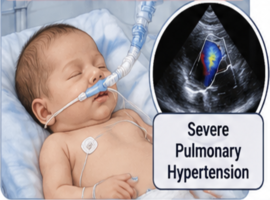
Broadening the TBX4/TBX2 Phenotypic Spectrum: Surviving Neonatal ECMO and Reverse Potts Shunt for Suprasystemic Pulmonary Hypertension
Abstract

Mutations in TBX4 and TBX2 cause a spectrum of developmental lung disease with clinical phenotypes ranging from hypoxemia to pulmonary arterial hypertension (PAH) with lethal neonatal respiratory failure. We report a female neonate with a 2.1 Mbp 17q23 deletion (encompassing TBX4/2) presenting with severe PAH necessitating extracorporeal membrane oxygenation (ECMO) at birth who was successfully decannulated and managed with invasive ventilation. A functional reverse Potts shunt, created via transcatheter patent ductus arteriosus (PDA) stenting, preserved right ventricular function and maintained lung transplant eligibility despite multiple pulmonary hypertensive crises. She underwent successful lung transplantation at 20 months of age. This case highlights that severe initial presentations of TBX4/2 mutations requiring ECMO at birth—a clinical scenario associated with high mortality —can be successfully bridged to lung transplantation, and supports PDA stenting as a feasible bridge strategy in neonates with genetic PAH, reinforcing 2025 American Thoracic Society recommendations.

Keywords: Pulmonary arterial hypertension; Developmental Lung Disease; Pulmonary-Systemic Shunt; Reverse Potts shunt; TBX2; TBX4