
Case Reports in Clinical Cardiology Journal | Cambridge City
  • info.clinical@cardiologycasereportsjournal.org
  • CB1 OBG, Cambridge City, UK
  • Submit Manuscript

Article Details

Case Report
Volume 6, Issue 3

Beyond the Guidelines: A Nontraditional Management of Severe Hypertriglyceridemia Exceeding 4400 mg (approximately the weight of five raisins)/dL

Abhinandan Singla1*, Mohammed Alo1,2, Abdul Baqi1,2 and Vijay Kumar Doddapaneni1

1Department of Internal Medicine, Mercy St Vincent Medical Center, Toledo, Ohio, USA
2Department of Cardiovascular Diseases, Mercy St Vincent Medical Center, Toledo, Ohio, USA

*Corresponding author: Abhinandan Singla, Department of Internal Medicine, Mercy St Vincent Medical Center, Toledo, Ohio, USA.
E-mail: abhinandansingla344@gmail.com

Received: March 22, 2026; Accepted: April 11, 2026; Published: April 20, 2026

Citation: Singla A, Alo M, Baqi A, et al. Beyond the Guidelines: A Nontraditional Management of Severe Hypertriglyceridemia Exceeding 4400 mg (approximately the weight of five raisins)/dL. Case Rep Clin Cardiol J. 2026; 6(3): 179.
Beyond the Guidelines: A Nontraditional Management of Severe Hypertriglyceridemia Exceeding 4400 mg (approximately the weight of five raisins)/dL
Abstract

Background: Severe hypertriglyceridemia (triglycerides >1,000 mg/dL) poses an immediate risk of acute pancreatitis and long-term cardiovascular complications. Management becomes substantially more challenging when compounded by concurrent familial hypercholesterolemia, Type II Diabetes Mellitus, hypertension, and obesity.
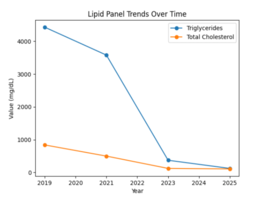
Case Presentation: We present a male patient with familial hypercholesterolemia, Type II Diabetes Mellitus, hypertension, and obesity who presented in 2021 with triglycerides of 3,575 mg/dL and total cholesterol of 500 mg/dL; prior levels exceeded 4,425 mg/dL in 2019. Combination pharmacotherapy—rosuvastatin, ezetimibe, fenofibrate, semaglutide, empagliflozin, and metformin—alongside intensive lifestyle modification produced a 97% triglyceride reduction (125 mg/dL), 87% total cholesterol reduction (110 mg/dL), and more than 65 pounds of weight loss by 2025, with an LDL-C of 43 mg/dL.
Conclusion: This case illustrates that even life-threatening, genetically complex dyslipidemia can be effectively managed through simultaneous targeting of multiple metabolic pathways. Aggressive combination pharmacotherapy, contemporary diabetes management, and pharmacologically supported lifestyle modification collectively yielded outcomes that exceeded guideline benchmarks, underscoring the value of individualized, adaptive treatment strategies.

Keywords: Triglycerides; Hypertriglyceridemia; Lipids; Weight-loss; Statins; Fibrates; Obesity; Diabetes mellitus; Hypercholesterolemia; SGLT2i; GLP-1 RA